Master linear sequences using the Box and Ring rule. Apply rules, find rules, and calculate any term in a sequence.
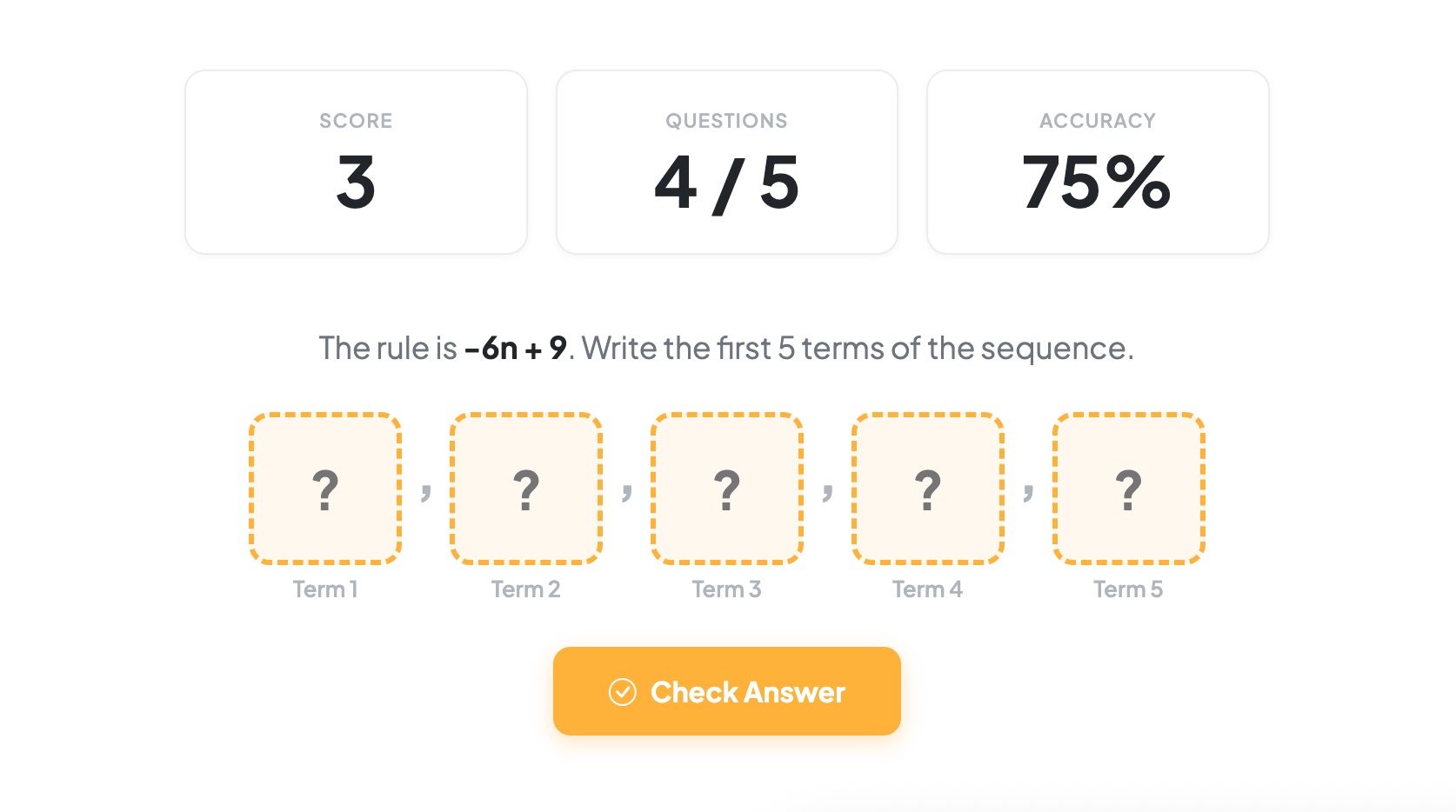
Practise linear sequences using the Box and Ring rule. Find the pattern, write the rule, and calculate any term in the sequence.
The common difference — how much the sequence goes up or down each time. This is the coefficient of n in the nth term rule.
The 0th term — the term before the sequence starts, found by subtracting the common difference from the first term.
Apply a rule, find a rule from a sequence, or use the rule to calculate a specific term. Build confidence at every stage.
You are given the nth term rule (e.g. 3n + 2) and must write the first 5 terms of the sequence.
You are shown the first 5 terms. Find the common difference (Box) and the 0th term (Ring) to write the nth term rule.
You are shown the first 5 terms and a target position (e.g. the 25th term). First find the rule, then use it to calculate the answer.
Play for a set time (1, 2, or 5 minutes) or answer a fixed number of questions (5, 10, 15, or 20). Both modes track your score and accuracy.
The Box and Ring method builds a solid foundation for algebra and generalising patterns
Core Y5/Y6 content that bridges primary maths into secondary algebra
Working forwards and backwards through a rule builds flexible mathematical thinking
Choose which type of sequence problem you want to practise.
Given the rule, write the first 5 terms
Given the sequence, find the Box and Ring
Find the rule, then calculate a specific term
Play against the clock or answer a set number of questions.
Answer as many as you can before time runs out
Answer a set number of questions at your own pace
Use the Box and Ring rule to solve each question.