Mental maths tests that are read aloud.
Pupils listen, write their answers on paper, then check them together. For classrooms and for home.
Three free tests in every year group. No account needed.
How it works
Nothing to install. Pupils need nothing but paper and a pencil.
Choose a test
Not sure yet? Try one of the free tests first. Pick a year group and a term.
Decide on timings
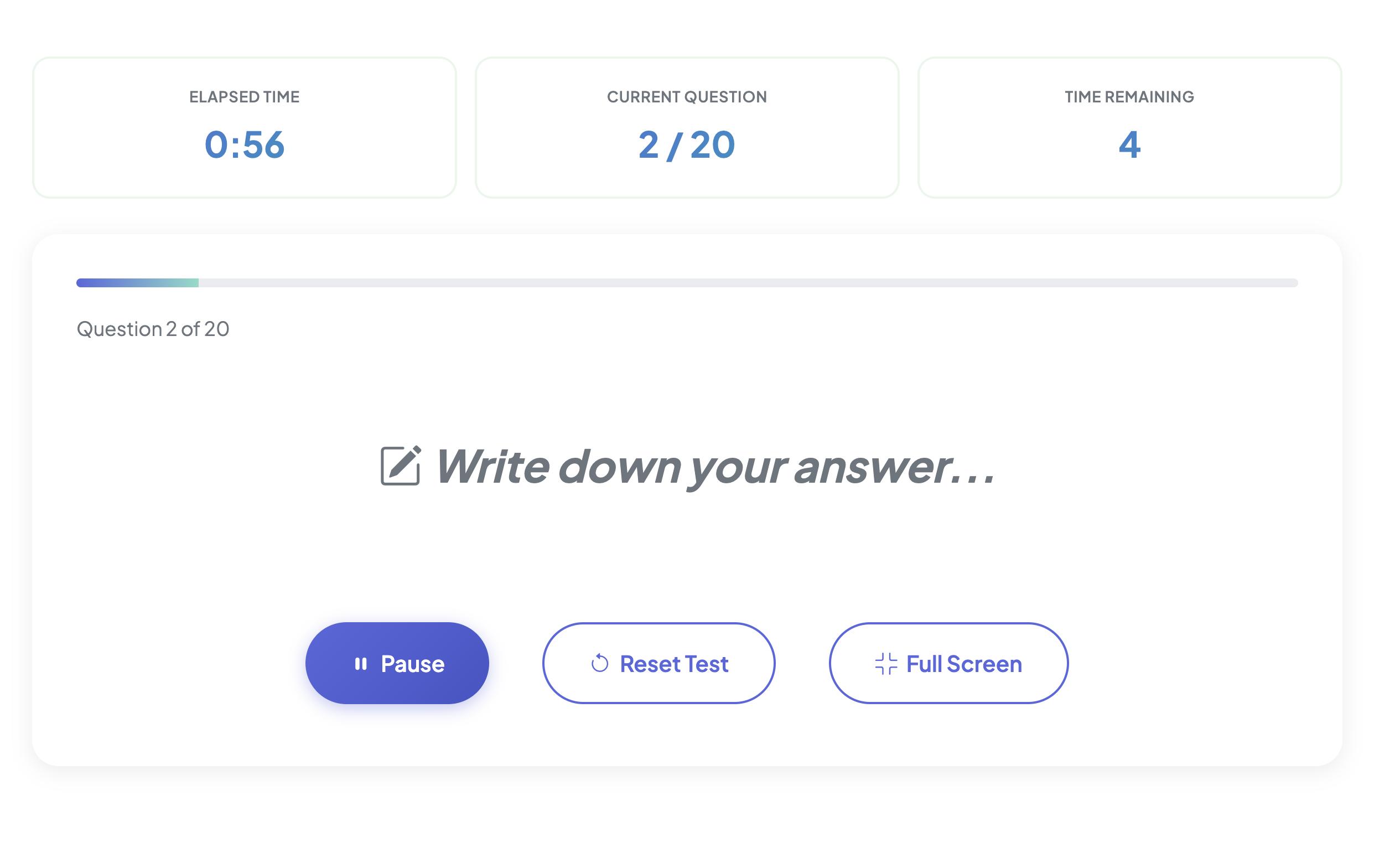
Give generous thinking time to start with, or shorten it to build pace. It's your call.
Run the test
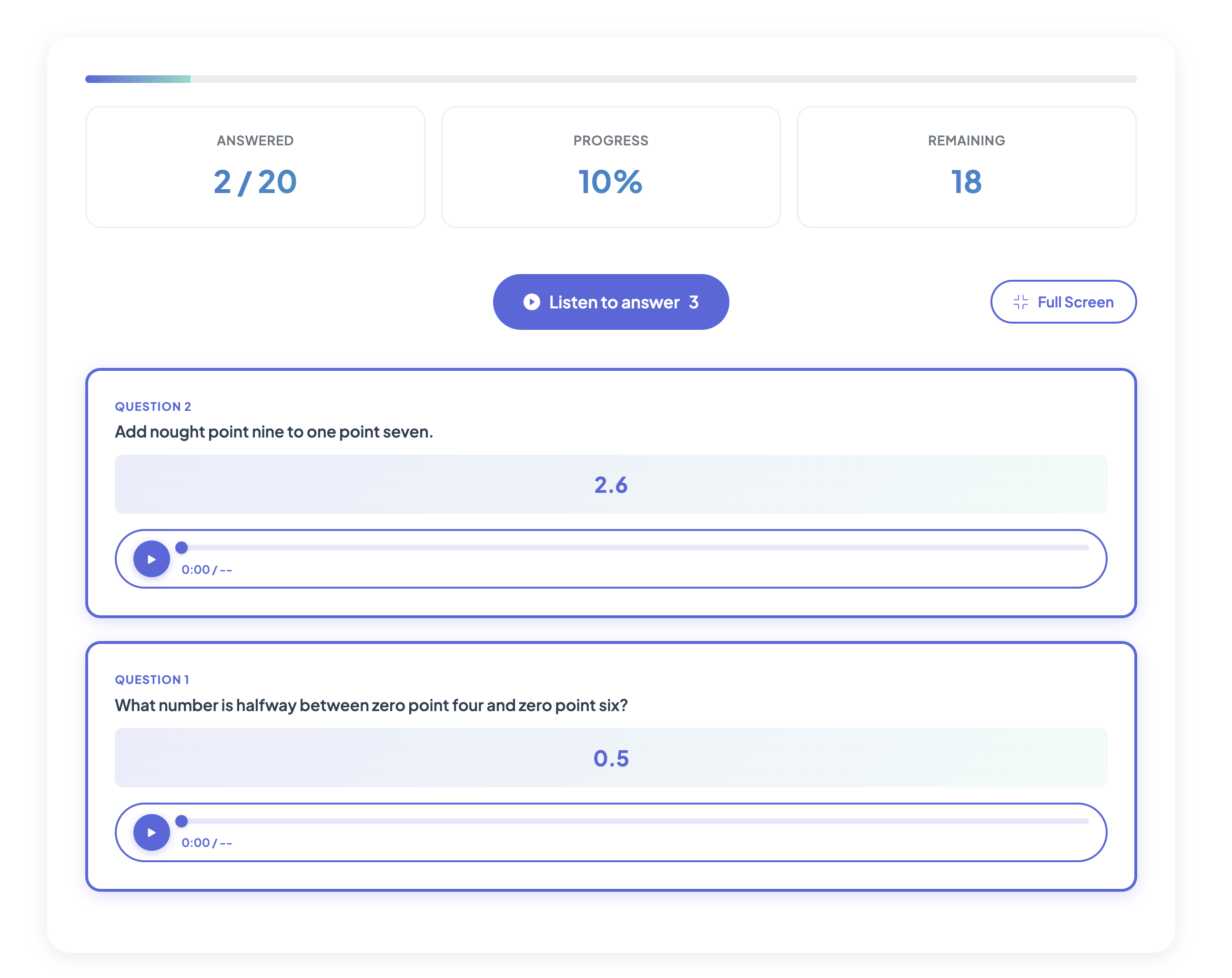
Each question is read aloud. Pupils jot their answers on paper.
Check together
Reveal the answers, then talk through solutions, methods and which answers make sense.
Try it before you decide
Each year group has three free tests, one for each term. Run one in class or at home and see exactly how it works.
Choose how you'll use it
The same curriculum-aligned tests, in two plans.
Practise at home
Start with the free tests. Register when you want more.
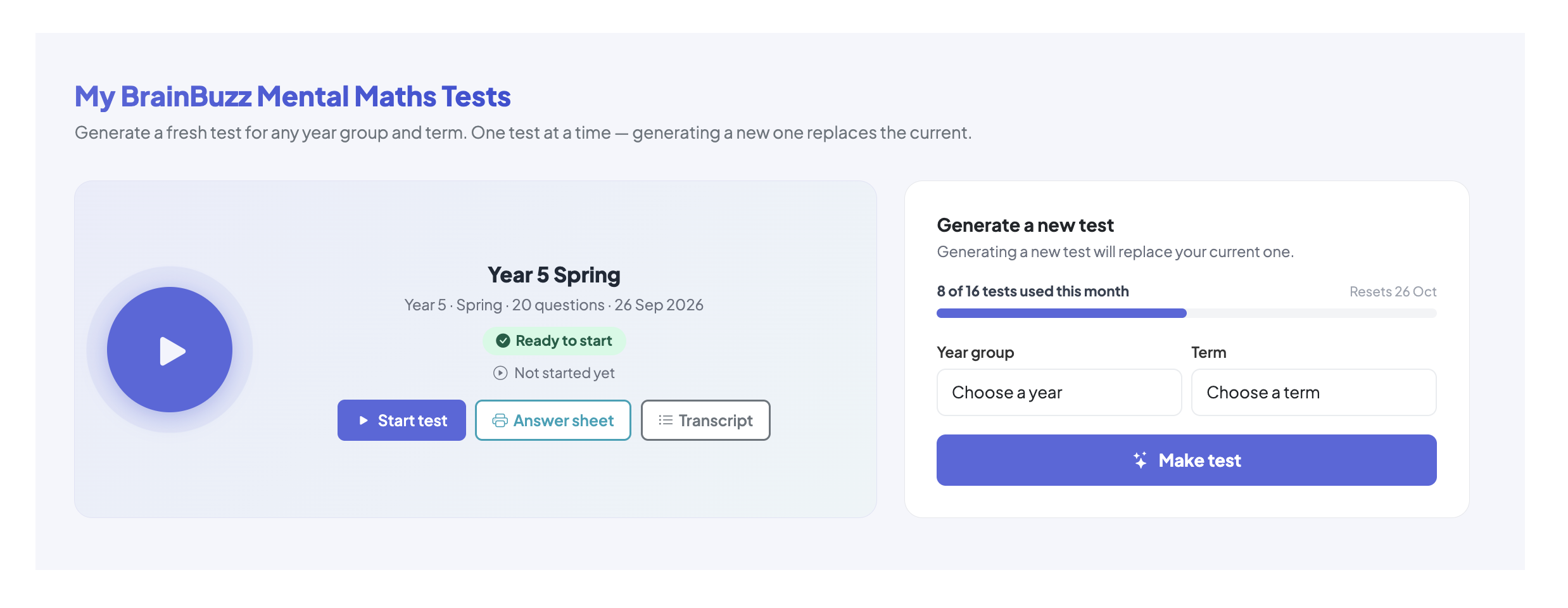
- Select one of the free sample tests, no account needed
- Registering lets you make custom tests for any year group and term
- The number of tests you can make each month depends on your plan
What happens next
- Pick a planChoose how many children, monthly or annual.
- Create your accountAdd your name and email, then pay securely.
- Start practisingGenerate your first test straight away.
Run it in class
Ready-made tests for Years 1–6, 10 per term, mapped to National Curriculum objectives.
- Pupils write on paper, with no devices or accounts for them
- Teachers get seats, managed from one simple dashboard
- Printable answer sheets included
- Set the thinking time to build pace across the year
What happens next
- RegisterTell us about your school and set up an admin.
- We review itWe confirm your details and send your invoice.
- Start using itFull access begins once the invoice is paid.
What children build
Confidence, resilience and quick recall, moving between every part of the curriculum.
Confidence
Regular, low-stakes practice makes a spoken question feel familiar rather than daunting.
Resilience
Missing one question? Move on, stay calm and finish strongly.
Speed of recall
Facts that come quickly leave more headspace for harder problems.
Switching topics
Fractions, then time, then multiplication, with no warm-up between them.
Focused listening
Holding a spoken question in mind, with no text to fall back on.
Smart jotting
Noting the key numbers as they listen frees up working memory to calculate.
What's covered
Every test draws on the National Curriculum objectives for its year group.
Number & Place Value
- Count to and across 100 forwards and backwards (Y1 NPV1)
- Read and write numbers to 100 in numerals and words (Y1 NPV2)
- Count in multiples of 2, 5 and 10 (Y1 NPV3)
- Identify one more and one less than a given number (Y1 NPV4)
Addition & Subtraction
- Read, write and interpret + − = statements (Y1 AS1)
- Add and subtract one-digit and two-digit numbers to 20 (Y1 AS2)
- Know and use number bonds to 20 (Y1 AS3)
- Solve one-step addition and subtraction problems (Y1 AS4)
Multiplication & Division
- Solve one-step multiplication problems using objects (Y1 MD1)
- Solve one-step division problems using objects (Y1 MD2)
Fractions
- Recognise, find and name a half of a shape or quantity (Y1 F1)
- Recognise, find and name a quarter of a shape or quantity (Y1 F2)
Measurement
- Compare, describe and solve problems for lengths and heights (Y1 M1)
- Compare, describe and solve problems for mass and weight (Y1 M2)
- Compare, describe and solve problems for capacity and volume (Y1 M3)
- Measure and record length, mass, volume using non-standard units (Y1 M4)
- Tell the time to the hour and half past (Y1 M5)
- Recognise and know the value of coins and notes (Y1 M6)
Geometry – Properties of Shape
- Recognise and name common 2D shapes (Y1 GPS1)
- Recognise and name common 3D shapes (Y1 GPS2)
Geometry – Position & Direction
- Describe position using directional language (Y1 GPD1)
Number & Place Value
- Count in steps of 2, 3 and 5 from 0 (Y2 NPV1)
- Count in tens from any number forward and backward (Y2 NPV2)
- Read and write numbers to at least 100 in numerals and words (Y2 NPV3)
- Recognise place value of each digit in a 2-digit number (Y2 NPV4)
- Compare and order numbers up to 100 using < > = (Y2 NPV5)
Addition & Subtraction
- Recall and use addition and subtraction facts to 20 fluently (Y2 AS1)
- Add and subtract numbers using concrete objects and pictures (Y2 AS2)
- Add and subtract 2-digit numbers mentally (Y2 AS3)
- Add and subtract using formal written column method (Y2 AS4)
- Solve problems with addition and subtraction (Y2 AS5)
- Recall and use number bonds to 100 (Y2 AS6)
- Use mental strategies such as partitioning and recombining to add and subtract (Y2 AS7)
Multiplication & Division
- Recall and use × and ÷ facts for 2, 5 and 10 tables (Y2 MD1)
- Understand multiplication as repeated addition (Y2 MD2)
- Understand division as sharing and grouping (Y2 MD3)
- Calculate mathematical statements using × and ÷ (Y2 MD4)
Fractions
- Recognise, find, name and write fractions 1/3, 1/4, 2/4 and 3/4 of a length, shape, set of objects or quantity (Y2 F1)
- Write simple fractions e.g. 1/2 of 6 = 3 (Y2 F2)
- Recognise equivalence of simple fractions (e.g. 2/4 = 1/2) (Y2 F3)
Measurement
- Choose and use standard units (m, cm, kg, l, ml) (Y2 M1)
- Compare and order lengths, mass, volume using < > = (Y2 M2)
- Recognise and use £ and p; solve simple money problems (Y2 M3)
- Tell the time to 5 minutes (12-hour clock) (Y2 M4)
- Know the number of minutes in an hour and hours in a day (Y2 M5)
Geometry – Properties of Shape
- Identify and describe properties of 2D shapes including symmetry (Y2 GPS1)
- Identify and describe properties of 3D shapes (Y2 GPS2)
- Compare and sort common 2D and 3D shapes by their properties (Y2 GPS3)
Geometry – Position & Direction
- Use mathematical vocabulary for position and direction (Y2 GPD1)
- Distinguish between rotation and reflection (Y2 GPD2)
- Order and arrange objects in patterns and sequences (Y2 GPD3)
Statistics
- Interpret and construct simple pictograms and tally charts (Y2 S1)
- Interpret and construct block diagrams and tables (Y2 S2)
- Answer questions about totalling and comparing data (Y2 S3)
Number & Place Value
- Count in multiples of 4, 8, 50 and 100 (Y3 NPV1)
- Read and write numbers to at least 1,000 (Y3 NPV2)
- Recognise place value in 3-digit numbers (H, T, O) (Y3 NPV3)
- Compare and order numbers up to 1,000 (Y3 NPV4)
Addition & Subtraction
- Add and subtract numbers mentally (3-digit ± units/tens/hundreds) (Y3 AS1)
- Add and subtract numbers up to 3 digits using formal column method (Y3 AS2)
- Estimate the answer and use inverse to check (Y3 AS3)
- Use known number facts to derive new facts (e.g. 6 + 7 → 60 + 70) (Y3 AS4)
- Use mental strategies including partitioning, compensation and near doubles (Y3 AS5)
- Estimate answers to calculations using rounding (Y3 AS6)
Multiplication & Division
- Recall and use × and ÷ facts for 3, 4 and 8 tables (Y3 MD1)
- Recall and use multiplication and division facts for the 3, 4 and 8 multiplication tables (Y3 MD2)
- Use short multiplication (formal written method) (Y3 MD3)
- Solve division problems using grouping and sharing, including remainders (Y3 MD4)
- Derive related multiplication and division facts (e.g. 4 × 6 → 40 × 6, 24 ÷ 6) (Y3 MD5)
Fractions
- Count up and down in tenths (Y3 F1)
- Recognise and show equivalent fractions using diagrams (Y3 F2)
- Add and subtract fractions with the same denominator (Y3 F3)
- Compare and order fractions with the same denominator (Y3 F4)
Measurement
- Measure and compare using standard metric units (Y3 M1)
- Measure the perimeter of simple 2D shapes (Y3 M2)
- Add and subtract amounts of money; give change (Y3 M3)
- Tell the time using 12-hour and 24-hour clocks (Y3 M4)
- Know units of time and convert (seconds, minutes, hours) (Y3 M5)
- Compare durations of events (Y3 M6)
Geometry – Properties of Shape
- Identify lines of symmetry in 2D shapes (Y3 GPS1)
- Identify right angles and recognise acute and obtuse angles (Y3 GPS2)
- Identify horizontal, vertical, parallel and perpendicular lines (Y3 GPS3)
Geometry – Position & Direction
- Describe movements as translations, reflections or rotations (Y3 GPD1)
Statistics
- Interpret and present data using bar charts (Y3 S1)
- Interpret and present data using tables (Y3 S2)
- Solve one-step and two-step questions using data (Y3 S3)
Number & Place Value
- Count in 1,000s; read and write numbers to 10,000 (Y4 NPV1)
- Recognise place value in 4-digit numbers (Y4 NPV2)
- Order and compare numbers beyond 1,000 (Y4 NPV3)
- Count forwards and backwards with negative numbers through 0 (Y4 NPV4)
- Read Roman numerals to 100 (I to C) (Y4 NPV5)
- Round any number to the nearest 10, 100 or 1,000 (Y4 NPV6)
Addition & Subtraction
- Add and subtract numbers with up to 4 digits using column method (Y4 AS1)
- Estimate and use inverse operations to check answers (Y4 AS2)
- Solve addition and subtraction multi-step problems (Y4 AS3)
- Use rounding to estimate and check answers to calculations (Y4 AS4)
Multiplication & Division
- Recall all multiplication tables to 12 × 12 fluently (Y4 MD1)
- Use place value and facts to multiply and divide mentally (Y4 MD2)
- Multiply and divide 2-digit and 3-digit by 1-digit (Y4 MD3)
- Recognise and use factor pairs and commutativity (Y4 MD4)
- Use known multiplication facts to derive related facts mentally (Y4 MD5)
Fractions
- Recognise equivalent fractions with different denominators (Y4 F1)
- Count up and down in hundredths (Y4 F2)
- Add and subtract fractions with same denominator (answers > 1) (Y4 F3)
- Find fractions of a quantity (Y4 F4)
Decimals
- Recognise and write decimal equivalents of tenths and hundredths (Y4 D1)
- Find the effect of dividing a one- or two-digit number by 10 and 100 (Y4 D2)
- Round decimals with one decimal place to nearest whole number (Y4 D3)
- Compare decimals with up to two decimal places (Y4 D4)
- Recognise decimal equivalents of a quarter, half and three quarters (Y4 D5)
Measurement
- Convert between units of measurement (km/m, kg/g, l/ml) (Y4 M1)
- Measure and calculate perimeter of rectilinear shapes (Y4 M2)
- Find the area of rectilinear shapes by counting squares (Y4 M3)
- Estimate, compare and calculate with measures (Y4 M4)
- Solve time problems using 12-hour and 24-hour clocks (Y4 M5)
Geometry – Properties of Shape
- Compare and classify geometric shapes based on properties (Y4 GPS1)
- Identify lines of symmetry in 2D shapes in different orientations (Y4 GPS2)
- Identify acute, obtuse and right angles (Y4 GPS3)
- Complete a simple symmetric figure (Y4 GPS4)
Geometry – Position & Direction
- Plot specified points and draw sides to complete polygons (Y4 GPD1)
- Describe translations and reflections of shapes (Y4 GPD2)
- Plot coordinates in the first quadrant (Y4 GPD3)
Statistics
- Interpret and construct bar charts and bar-line charts (Y4 S1)
- Interpret and construct time graphs (line graphs) (Y4 S2)
- Solve comparison, sum and difference problems from charts (Y4 S3)
Number & Place Value
- Read and write numbers to 1,000,000 (Y5 NPV1)
- Recognise place value in numbers to 1,000,000 (Y5 NPV2)
- Count forwards/backwards in steps of powers of 10 (Y5 NPV3)
- Interpret negative numbers in context; count through zero (Y5 NPV4)
- Read Roman numerals to 1,000 (M) and recognise years (Y5 NPV5)
- Round any number up to 1,000,000 to required degree (Y5 NPV6)
Addition & Subtraction
- Add and subtract numbers with more than 4 digits (column method) (Y5 AS1)
- Add and subtract mentally with increasingly large numbers (Y5 AS2)
- Use rounding and estimation to check answers (Y5 AS3)
- Add and subtract decimals (Y5 AS4)
- Use estimation to check the reasonableness of answers (Y5 AS5)
Multiplication & Division
- Identify multiples and factors, including common factors (Y5 MD1)
- Identify prime numbers up to 100 (Y5 MD2)
- Recognise and use square numbers and square roots (Y5 MD3)
- Recognise and use cube numbers (Y5 MD4)
- Multiply 4-digit numbers by 1-digit (short multiplication) (Y5 MD5)
- Multiply numbers up to 4 digits by 2-digit (long multiplication) (Y5 MD6)
- Divide 4-digit numbers by 1-digit (short division) (Y5 MD7)
- Multiply and divide by 10, 100 and 1,000 (Y5 MD8)
- Use known facts to multiply and divide numbers mentally (e.g. ×20, ×0.5) (Y5 MD9)
Fractions
- Compare and order fractions with different denominators (Y5 F1)
- Identify, name and write equivalent fractions of a given fraction (Y5 F2)
- Convert between mixed numbers and improper fractions (Y5 F3)
- Add and subtract fractions with different denominators (Y5 F4)
- Multiply fractions and mixed numbers by a whole number (Y5 F5)
- Calculate fractions of amounts (Y5 F6)
Decimals
- Read and write decimals with up to 3 decimal places (Y5 D1)
- Recognise the place value of each digit in a decimal (Y5 D2)
- Multiply and divide decimals by 10, 100 and 1,000 (Y5 D3)
- Round decimals to a specified number of decimal places (Y5 D4)
- Add and subtract decimals (same number of d.p.) (Y5 D5)
Percentages, Ratio & Proportion
- Recognise the % symbol; understand as per hundred (Y5 PRP1)
- Write percentages as fractions and as decimals (Y5 PRP2)
- Find simple percentages of amounts (Y5 PRP3)
Measurement
- Convert between metric units (e.g. km to m, g to kg) (Y5 M1)
- Calculate area and perimeter of rectangles (Y5 M2)
- Calculate area of composite rectilinear shapes (Y5 M3)
- Estimate volume using cubes (Y5 M4)
- Solve problems involving converting units of time (Y5 M5)
Geometry – Properties of Shape
- Distinguish between regular and irregular polygons (Y5 GPS1)
- Know properties of triangles (equilateral, isosceles, scalene) (Y5 GPS2)
- Know that angles in a triangle sum to 180° (Y5 GPS3)
- Know that angles on a straight line sum to 180° (Y5 GPS4)
- Know that angles at a point sum to 360° (Y5 GPS5)
- Use degrees to measure and classify angles (Y5 GPS6)
Geometry – Position & Direction
- Identify, describe and represent the position of a shape after reflection (Y5 GPD1)
- Reflect shapes in a mirror line (axes aligned) (Y5 GPD2)
Statistics
- Interpret and construct line graphs (Y5 S1)
- Solve problems using information presented in line graphs (Y5 S2)
- Read and interpret tables including timetables (Y5 S3)
Number & Place Value
- Read and write numbers to 10,000,000 (Y6 NPV1)
- Recognise place value in numbers to 10,000,000 (Y6 NPV2)
- Use negative numbers in context; calculate intervals across 0 (Y6 NPV3)
- Round any whole number to a required degree of accuracy (Y6 NPV4)
Addition & Subtraction
- Perform mental addition and subtraction with large numbers (Y6 AS1)
- Add and subtract decimals including different decimal places (Y6 AS2)
- Solve multi-step problems deciding which operations to use (Y6 AS3)
Multiplication & Division
- Multiply multi-digit numbers by 2-digit (long multiplication) (Y6 MD1)
- Divide 4-digit by 2-digit using long division (Y6 MD2)
- Use order of operations (BODMAS/BIDMAS) (Y6 MD3)
- Identify common factors, common multiples and prime numbers (Y6 MD4)
- Multiply and divide decimals by 10, 100, 1000 (Y6 MD5)
Fractions
- Add and subtract fractions with different denominators (Y6 F1)
- Multiply simple pairs of proper fractions (Y6 F2)
- Divide proper fractions by whole numbers (Y6 F3)
- Calculate fractions of amounts (Y6 F4)
- Simplify fractions using common factors (Y6 F5)
Decimals
- Add and subtract decimals with different numbers of d.p. (Y6 D1)
- Multiply and divide decimals by 10, 100 and 1,000 (Y6 D2)
- Round decimals to required degree of accuracy (Y6 D3)
- Solve problems involving decimals in context (Y6 D4)
- Convert between fractions, decimals and percentages (Y6 D5)
Percentages, Ratio & Proportion
- Find percentages of amounts (e.g. 15% of £240) (Y6 PRP1)
- Compare fractions, decimals and percentages (Y6 PRP2)
- Solve problems involving percentage change (increase/decrease) (Y6 PRP3)
- Understand ratio notation and simplify ratios (Y6 PRP4)
- Solve proportion problems using unitary method (Y6 PRP5)
- Use scale factors to solve proportion problems (Y6 PRP6)
Algebra
- Use symbols and letters to represent missing numbers (Y6 A1)
- Use simple formulae (Y6 A2)
- Generate and describe linear number sequences (Y6 A3)
- Enumerate possibilities of combinations of two variables (Y6 A4)
- Use coordinates in the first quadrant (Y6 A5)
Measurement
- Convert between miles and kilometres (approximation) (Y6 M1)
- Recognise and use common imperial units (miles, pints, pounds) (Y6 M2)
- Calculate area of triangles and parallelograms (Y6 M3)
- Calculate volume of cuboids (Y6 M4)
- Solve problems involving measurement and conversion (Y6 M5)
Geometry – Properties of Shape
- Know properties of quadrilaterals (Y6 GPS1)
- Illustrate and name parts of a circle (radius, diameter, chord) (Y6 GPS2)
- Recognise, describe and build 3D shapes including nets (Y6 GPS3)
- Find missing angles in triangles and quadrilaterals (Y6 GPS4)
Geometry – Position & Direction
- Plot coordinates in all four quadrants (Y6 GPD1)
- Translate shapes on a coordinate grid (Y6 GPD2)
- Reflect shapes in axes and other mirror lines (Y6 GPD3)
Statistics
- Interpret and construct pie charts (Y6 S1)
- Calculate and interpret the mean as an average (Y6 S2)
- Solve problems using information in charts, graphs and tables (Y6 S3)
Number & Place Value
- Order positive and negative integers of any size (Y7 NPV1)
- Use index notation for powers (squares, cubes) (Y7 NPV2)
- Understand and use place value for decimals (Y7 NPV3)
- Round numbers to a given number of significant figures (Y7 NPV4)
Addition & Subtraction
- Add and subtract integers and decimals in any context (Y7 AS1)
- Add and subtract negative numbers (Y7 AS2)
Multiplication & Division
- Use prime factorisation (factor trees) (Y7 MD1)
- Find highest common factor (HCF) (Y7 MD2)
- Find lowest common multiple (LCM) (Y7 MD3)
- Multiply and divide directed (negative) numbers (Y7 MD4)
- Multiply and divide decimals including by decimals (Y7 MD5)
Fractions
- Multiply fractions by fractions (Y7 F1)
- Divide fractions by fractions (Y7 F2)
- Express one quantity as a fraction of another (Y7 F3)
- Calculate fractions of amounts in complex contexts (Y7 F4)
Decimals
- Order and compare decimals including negatives (Y7 D1)
- Multiply and divide decimals including by decimals (Y7 D2)
Percentages, Ratio & Proportion
- Solve percentage problems including reverse percentage (Y7 PRP1)
- Divide quantities in a given ratio (Y7 PRP2)
- Solve proportion problems (unitary and ratio methods) (Y7 PRP3)
- Use scale factors in similar shapes (Y7 PRP4)
- Express one quantity as a percentage of another (Y7 PRP5)
Algebra
- Substitute values into expressions and formulae (Y7 A1)
- Simplify expressions by collecting like terms (Y7 A2)
- Expand single brackets (Y7 A3)
- Solve one-step linear equations (Y7 A4)
- Solve two-step linear equations (Y7 A5)
- Recognise arithmetic sequences and find the nth term rule (Y7 A6)
- Use coordinates in all four quadrants (Y7 A7)
- Generate sequences from algebraic rules (Y7 A8)
Measurement
- Calculate area of compound shapes (Y7 M1)
- Calculate area of trapeziums (Y7 M2)
- Use and convert between metric units fluently (Y7 M3)
- Solve problems with time, distance and speed (Y7 M4)
Geometry – Properties of Shape
- Understand and use vertically opposite angles (Y7 GPS1)
- Understand and use angles on parallel lines (alternate, corresponding, co-interior) (Y7 GPS2)
- Construct triangles and other shapes using ruler and compasses (Y7 GPS3)
- Calculate interior and exterior angles of polygons (Y7 GPS4)
Geometry – Position & Direction
- Describe and perform translations using vectors (Y7 GPD1)
- Rotate shapes about a given centre (Y7 GPD2)
- Describe transformations fully (Y7 GPD3)
Statistics
- Calculate the mode, median, mean and range (Y7 S1)
- Compare distributions using averages and range (Y7 S2)
- Interpret and construct frequency tables (Y7 S3)
- Use frequency tables to find averages and range (Y7 S4)
- Interpret and construct stem-and-leaf diagrams (Y7 S5)
Probability
- Understand probability as a measure of likelihood (Y7 P1)
- Use the probability scale from 0 to 1 (Y7 P2)
- List all outcomes of a single event (Y7 P3)
- Calculate the theoretical probability of an event (Y7 P4)
- Use frequency trees and two-way tables (Y7 P5)
Number & Place Value
- Understand the concept of a number in standard form (Y8 NPV3)
- Convert between ordinary numbers and standard form (Y8 NPV1)
- Calculate with numbers in standard form (Y8 NPV2)
Addition & Subtraction
- Add and subtract with fractions and mixed numbers (Y8 AS1)
- Apply addition and subtraction in algebraic contexts (Y8 AS2)
Multiplication & Division
- Multiply and divide fractions and mixed numbers (Y8 MD1)
- Apply multiplication and division in algebraic contexts (Y8 MD2)
- Use index laws for multiplication and division (Y8 MD3)
Fractions
- Apply fractions in algebraic and geometric contexts (Y8 F1)
- Use fractions in ratio and proportion problems (Y8 F2)
Decimals
- Use decimals in algebraic and geometric contexts (Y8 D1)
- Understand recurring and terminating decimals (Y8 D2)
- Convert fractions to recurring decimals and vice versa (Y8 D3)
Percentages, Ratio & Proportion
- Solve problems involving simple interest (Y8 PRP1)
- Solve problems involving compound interest and depreciation (Y8 PRP2)
- Understand and use direct proportion (Y8 PRP3)
- Understand and use inverse proportion (Y8 PRP4)
- Apply percentage increase/decrease in real contexts (VAT, discount) (Y8 PRP5)
Algebra
- Expand and simplify double brackets (Y8 A1)
- Factorise expressions into a single bracket (Y8 A2)
- Form and solve equations from word problems (Y8 A3)
- Solve linear equations with unknowns on both sides (Y8 A4)
- Plot and interpret straight-line graphs (y = mx + c) (Y8 A5)
- Understand gradient and y-intercept (Y8 A6)
- Recognise and use geometric sequences (Y8 A7)
- Solve simultaneous equations graphically (Y8 A8)
Measurement
- Calculate the circumference of a circle (Y8 M1)
- Calculate the area of a circle (Y8 M2)
- Calculate the volume of prisms (Y8 M3)
- Calculate the volume of cylinders (Y8 M4)
- Calculate the surface area of cuboids and prisms (Y8 M5)
Geometry – Properties of Shape
- Understand congruence and similarity of shapes (Y8 GPS1)
- Apply Pythagoras theorem to find missing sides (Y8 GPS3)
- Use properties of circles (tangent, chord, arc) (Y8 GPS4)
Geometry – Position & Direction
- Enlarge shapes by a given scale factor from a centre (Y8 GPD1)
- Describe enlargements fully including scale factor and centre (Y8 GPD2)
- Identify invariant properties under transformations (Y8 GPD3)
Statistics
- Construct and interpret scatter graphs (Y8 S1)
- Describe correlation (positive, negative, none) (Y8 S2)
- Interpret and draw frequency diagrams and histograms (equal class width) (Y8 S3)
- Compare distributions from charts and averages (Y8 S4)
Probability
- Compare experimental and theoretical probability (Y8 P1)
- Use sample space diagrams for combined events (Y8 P2)
- Use the property that probabilities sum to 1 (Y8 P3)
- Calculate probability from Venn diagrams (Y8 P4)
- Understand mutually exclusive and exhaustive events (Y8 P5)
Questions
Can I try it first?
Yes. Every year group has three free tests, one for each term, and you don't need an account to run them.
Do children need a device?
Pupils write their answers on paper. In class the teacher plays the audio. At home, a phone, tablet or computer plays it.
Which year groups are covered?
Every year group from Year 1 to Year 6, for both home plans and school subscriptions.
Can I cancel?
Home plans have no contracts and can be cancelled at any point from your account dashboard. School subscriptions are annual and invoiced for the full year.
How do schools pay?
You register, we review your details and send an invoice, and access starts once it's paid.
Is payment secure?
Home payments are taken by Stripe. We never store your card details on our servers.
Ready to start?
Try a free test now, or pick a plan whenever you're ready.